Running your own AI models has become a normal way to cut cost and keep data in house. The catch is that the tools that manage those GPUs are new, fast-moving software, and they often sit behind a simple reverse proxy and nothing else. On 9 November 2026 the US cyber agency CISA added a critical flaw in one of them, GPUStack, to its Known Exploited Vulnerabilities (KEV) list. The project's own advisory says it has been exploited in the wild. We have not tested the flaw and this article leaves out how it is triggered. It is a guide to updating and checking an AI server you run or pay someone to run.
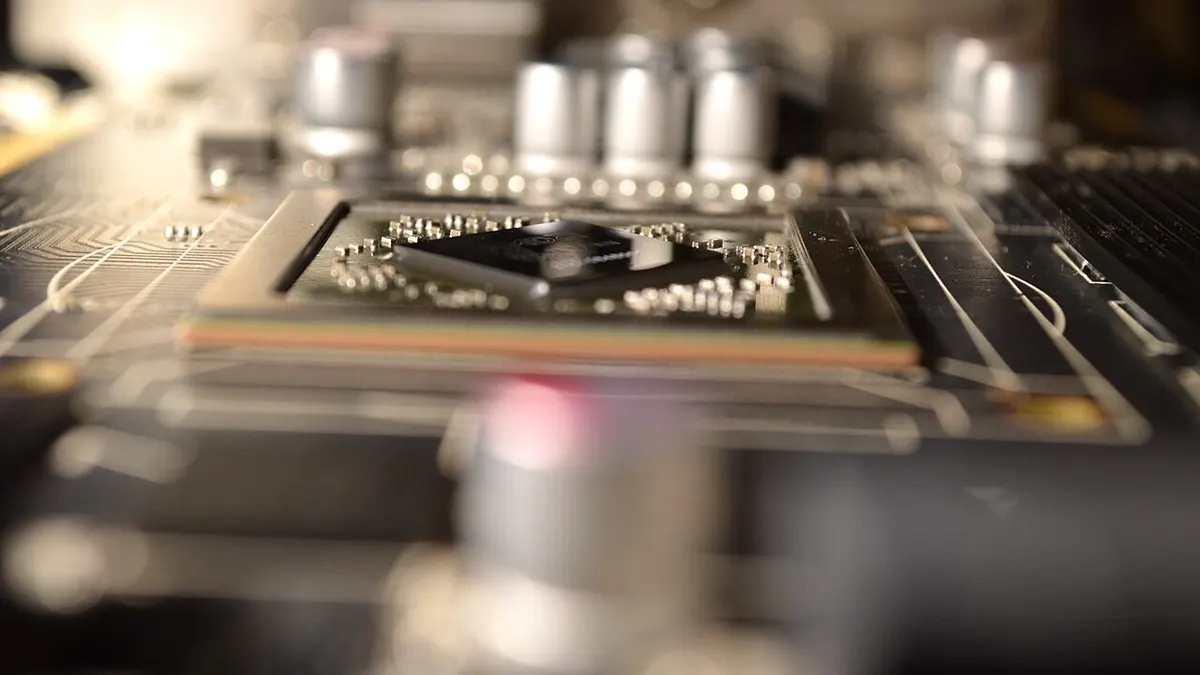 GPU servers are expensive, powerful and often exposed with little more than a proxy in front. Photo: Nick Stathas, CC BY-SA 4.0, via Wikimedia Commons
The short answer
- What it is: CVE-2026-102895, a critical authentication bypass in GPUStack before version 2.2.0 (CVSS 3.1 vector: network, low complexity, no privileges, no user interaction, high impact on confidentiality, integrity and availability).
- Cause: the server trusts where a request appears to come from. By default, a request that looks local is treated as the built-in administrator.
- Is it exploited: CISA added it to KEV on 9 November 2026 with a due date of 12 November 2026 for US federal agencies. The advisory says it was observed exploited against a v2.1.1 deployment.
- What an attacker gets: the advisory describes unauthenticated administrative access, persistent admin API keys, worker and cloud-provider secrets, and code execution on worker hosts.
- What to do today: update to the latest stable release (2.2.0 is the first fixed version), then review users, API keys and custom backends.
What the sources say
The vendor advisory is a GitHub security advisory, GHSA-gj9m-f8ph-pmhr, published on 31 July 2026 and rated Critical. It explains that in GPUStack before v2.2.0 the function that identifies the current user promotes any request whose source is treated as loopback (the machine talking to itself) to the built-in administrator account, when the setting force_auth_localhost is false. That is the default.
The advisory names two ways an outside request can end up looking local:
- A same-host reverse proxy. This is a very common way to run self-hosted software: a web server such as nginx on the same machine forwards traffic to the app on 127.0.0.1. In that shape every remote request reaches GPUStack from the local address, so the local-means-admin rule fires. The advisory says no header or credential is required.
- A forwarded-address header. A request carrying a forged
X-GPUStack-Real-IPvalue can also cause the source to be treated as local.
Either path gives, in the advisory's words, full unauthenticated administrative access over the network. It lists enumerating and changing users, models, workers and configuration, creating persistent admin API keys valid from any address, and reading worker credentials and cloud or provider secrets. It adds that, combined with an admin-only function for defining custom inference backends, this leads to code execution on worker hosts. It reports that the flaw was observed exploited against a v2.1.1 deployment, with attacker-created custom backends running reverse shells.
CISA's entry is titled "GPUStack Improper Authentication Vulnerability", lists the weakness types CWE-287, CWE-290 and CWE-346, and marks known ransomware use as unknown. The advisory credits several independent reporters, including Nikko Enggaliano, Wei Yunzhou, and Rui Yang and Haoyu Wang of Johns Hopkins University, and credits Javier Sixto for reporting the active exploitation.
What we could not confirm: how many servers are exposed or compromised, or who is behind the attacks. We are adding no figures the sources do not give.
Why this matters for companies running AI
An inference server is not just a web app. It holds model files, API keys for paid model providers, credentials for the cloud accounts that supply GPUs, and sometimes access to internal data that you feed to models. Admin rights on it can mean all of that, and code running on the machines that hold your GPUs.
There is also a financial angle. Stolen GPU capacity and stolen provider keys are worth money, and the first sign is often a surprise bill. And there is a lesson in the design: the flaw is not an exotic bug but a trust shortcut, "requests from this machine are safe", that stops being true the moment a proxy sits in front. Many self-hosted AI tools make the same assumption, so this is a good prompt to check the others.
If your team in India or elsewhere has tried an open-source model stack for a pilot, remember pilots tend to stay running. An old test server with default settings is exactly the kind of machine this affects.
What to do this week
- Find every GPUStack install. Include pilots, staging machines and ones a developer set up on a cloud GPU. Check the version in the web console or with your package tool.
- Update to the latest stable release. Version 2.2.0 is the first with the fix, which removes the loopback auto-admin path and hardens client address and header handling. The project's 2.2.2 notes list two other security fixes in an earlier range of versions, so do not stop at the minimum.
- If you cannot update today, use the advisory's workarounds. Set
force_auth_localhost=true. Make sure your reverse proxy cannot make outside traffic look like loopback, and strip any client-suppliedX-GPUStack-Real-IPheader at the edge. Keep the API reachable only over a VPN or behind edge authentication. - Take the API off the open internet. An AI control plane belongs behind a VPN, a private network or an authenticating gateway, not on a public address.
- Audit what an admin could have changed. List users and API keys and delete any you did not create. Look at custom inference backends and remove ones you do not recognise, since the reported attacks used them. Check recently added workers and models too.
- Rotate secrets. Replace cloud-provider credentials, model-provider API keys and any worker tokens stored in or reachable from GPUStack, if the server was reachable before the update.
- Look at the hosts. Check worker machines for unfamiliar processes, new scheduled jobs and unexpected outbound connections. Keep logs before rebuilding anything.
Common mistakes to avoid
- Updating and moving on. Admin API keys created before the fix do not disappear when you upgrade.
- Trusting "it is only on localhost". Behind a same-host proxy, the app cannot tell outside visitors from local ones.
- Forgetting forwarded headers. A header the client can set should never decide who is an administrator, and your proxy should drop it on the way in.
- Leaving pilots running. Old test installs are rarely patched and often hold real keys.
- Ignoring custom backends. An unknown backend entry is a strong signal worth investigating.
- Rotating nothing. If the server was reachable, the secrets it held should be treated as seen.
Where Susraj Tech fits in
We build AI automation and custom software, and secure deployment of internal AI tools is part of that. If you want a review of how your model servers, proxies and keys are set up, our AI automation team can help, or you can contact us. Our earlier posts on the SonicWall SSL VPN flaw and the cPGuard update compromise show the same habit of rotating secrets after a server-side exposure.
Checklist
- List every GPUStack install, including pilots and staging machines.
- Record the version of each and mark anything below 2.2.0.
- Update to the latest stable release and confirm the version afterwards.
- Set
force_auth_localhost=trueif the update must wait. - Strip
X-GPUStack-Real-IPat the reverse proxy and confirm outside traffic cannot look like loopback. - Move the API behind a VPN or an authenticating gateway.
- Review users and API keys and delete any you did not create.
- Review custom inference backends, workers and models for unknown entries.
- Rotate cloud-provider, model-provider and worker credentials if the server was reachable.
- Check worker hosts for unfamiliar processes and outbound connections.
Key takeaways
- CVE-2026-102895 lets an outside attacker become GPUStack administrator without credentials on versions before 2.2.0, in default configuration.
- CISA added it to KEV on 9 November 2026, and the project advisory reports exploitation with attacker-created backends running reverse shells.
- Updating is necessary but not sufficient. Review API keys, users, backends and stored secrets afterwards.
- Never let a source address or a client-controlled header decide who is an administrator.
- Keep AI management interfaces off the public internet.
Sources
- GPUStack GitHub security advisory GHSA-gj9m-f8ph-pmhr: authentication bypass via trusted loopback source (published 31 July 2026)
- GPUStack releases, including the v2.2.2 security notes
- CISA Known Exploited Vulnerabilities catalogue: CVE-2026-102895, GPUStack Improper Authentication Vulnerability (added 9 November 2026)