
If your business phones, call centre dialler or WhatsApp-to-voice bridge run through FreeSWITCH, today is a patching day. On 9 November 2026 the US cyber agency CISA added a critical FreeSWITCH flaw to its Known Exploited Vulnerabilities (KEV) list, which is the short list of bugs that attackers are using now, not someday. The project's own security advisory goes further and says the attack path has been seen in the wild. We have not tested the flaw and this article leaves out how it is triggered. It is a patch and hardening guide for people who run or buy phone systems.
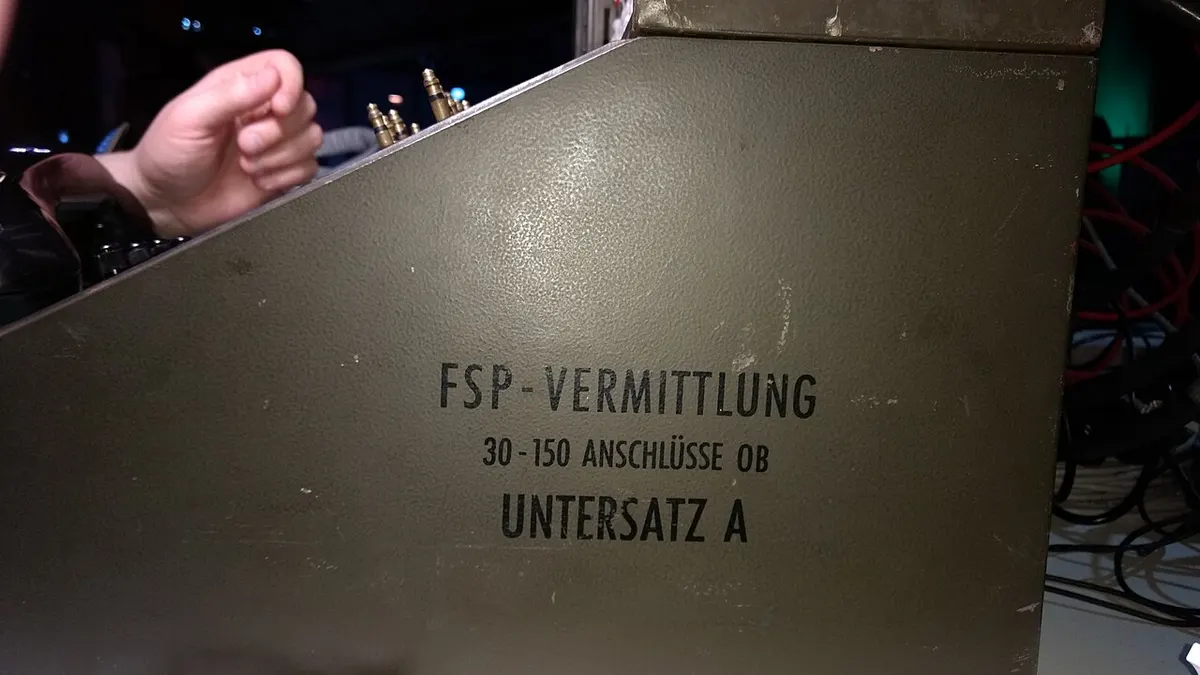 A SIP server is today's switchboard: whoever can send it a message can sometimes tell it what to do. Photo: Ismael Olea, CC BY 4.0, via Wikimedia Commons
The short answer
- What it is: CVE-2026-116779, a critical command-injection flaw in FreeSWITCH, scored 9.8 out of 10 (CVSS 3.1) with network access, low complexity, no privileges and no user interaction.
- Who is affected: FreeSWITCH 1.11.2 and earlier. Version 1.11.3 and later is patched.
- Is it exploited: CISA added it to KEV on 9 November 2026 and set a due date of 12 November 2026 for US federal agencies. The advisory says exploitation of this path has been observed in the wild.
- What it can do: the advisory describes command execution as the FreeSWITCH process user, disclosure of configuration and credentials, and full control over calls.
- What to do today: upgrade to 1.11.3 or later. If that takes a day or two, disable SIP chat on profiles that do not need it and remove passwordless directory users.
What the sources say
The vendor advisory is a GitHub security advisory (GHSA-mg63-h38w-8p9p) published on 28 October 2026. Its title describes the problem plainly: an inbound SIP MESSAGE can select the api chat protocol and run FreeSWITCH API commands. SIP MESSAGE is the part of the SIP protocol used for short text messages, in the same family as the signalling that sets up calls. FreeSWITCH can hand those messages to internal handlers called chat protocols, and the advisory says one of those handlers could be reached from the network and used to run API commands.
Three details from the advisory matter for risk:
- The default setup is exposed. SIP profiles accept inbound MESSAGE unless
enable-chatis set to false, and the stock configuration leaves chat on for the internal and external profiles. The inbound access control list does not cover MESSAGE. - Prerequisites are low. An attacker needs one accepted SIP MESSAGE. Where message authentication is enforced, any single account will do. Installs that still carry the sample
default.xmldirectory file have a default user with no password or password hash, so no real account is needed there unless empty passwords are rejected. - There is a second route. Where the
mod_luamodule is loaded, which the stock configuration does, inline Lua is described as a second place where the injected input can run.
CISA's catalogue entry is titled "SignalWire FreeSwitch Code Injection Vulnerability" and lists the weakness types CWE-77, CWE-78 and CWE-749. It was added on 9 November 2026 with a due date of 12 November, and marks known ransomware use as unknown. The advisory credits the researchers Örn Arnarson and Gunnlaugur for the report.
What we could not confirm: who is exploiting the flaw, against which targets, or how many servers are affected. The sources we read give no numbers and we are not adding any.
Why this matters even if you are not a telecom company
FreeSWITCH is open-source software that sits inside a large number of products. It can be the engine of a company PBX, a contact-centre dialler, a call recording system, a voicemail platform or a hosted phone service. Many owners of those systems never see the word FreeSWITCH, because it ships inside a vendor's product or an agency's custom build.
The risk has three parts. First, command execution on a phone server gives an attacker a foothold inside the network where the server sits, often next to customer data. Second, FreeSWITCH holds secrets: SIP account credentials, gateway passwords for your telecom carrier and API keys for any integrations. Stolen carrier credentials are commonly used for toll fraud, which means a large bill for calls you never made. Third, an attacker with call control can listen to, redirect or record conversations, which is a privacy and compliance problem on top of a security one.
If you run an Indian business with a cloud dialler for sales or support, the same logic holds. Your provider may not tell you which software is underneath, so asking is part of the job.
What to do this week
- Find out whether you run FreeSWITCH. Search servers, containers and vendor documentation for it. Check the version with
fs_cli -x versionor the equivalent on your system. - Upgrade to 1.11.3 or later. Use your package source or your vendor's build, and test calls after the upgrade. The fix adds a new per-profile setting,
enable-chat-api-proto, which is off by default. A message that selects that handler where it is not enabled is rejected with a 403 response and a log entry. - If you cannot upgrade today, apply the advisory's workarounds. Set
enable-chatto false on every SIP profile that does not need inbound chat. Remove directory users with no password or password hash, since the stock vanilla configuration ships two such users. Enablingdisable_system_api_commandshelps but the advisory says it does not close the route, and requiring message authentication on its own is not enough because it is already the default from 1.10.7. - Limit who can reach SIP. Put the SIP ports behind a firewall or an allow-list of your carrier and office addresses. A phone server does not need to answer the whole internet.
- Look for signs of use. Review FreeSWITCH logs for MESSAGE requests from unfamiliar addresses and for API commands you did not run. Check for new files, new scheduled jobs and unexpected outbound connections from the server. CISA's entry notes that forensic triage is available, so keep logs before you rebuild anything.
- Rotate secrets if you find anything or cannot rule it out. That means SIP account passwords, carrier and gateway credentials, API keys and any password stored in the FreeSWITCH configuration.
- Ask your providers. If a vendor or agency runs FreeSWITCH for you, send one written question: which version, when was 1.11.3 applied, and what did you check.
Common mistakes to avoid
- Relying on message authentication alone. The advisory says it is not sufficient. A single valid account, or a leftover passwordless one, is enough for the described route.
- Leaving sample configuration in production. The stock directory ships users without passwords. They are examples, and they should not survive on a live server.
- Patching the server but not the copies. Test, staging and failover machines are often forgotten, and they hold the same credentials.
- Assuming it is only for large telecom operators. The advisory says the default configuration is vulnerable, so small installs count.
- Skipping the logs. The 28 October advisory predates today's KEV listing, so a server unpatched for ten days has already been exposed for that window.
- Exposing SIP to the whole internet out of habit. Many setups need it open only to a carrier and a few office addresses.
Where Susraj Tech fits in
We build custom software and integrations, and phone and messaging systems are a common source of weak spots in them. If you want a second pair of eyes on how a dialler, call recorder or CRM telephony link is wired up, our custom software development team can review it, or you can get in touch. The same pattern of a network-facing service with default settings appeared in our post on the SonicWall SSL VPN flaw listed by CISA.
Checklist
- List every server, container and vendor product that runs FreeSWITCH.
- Record each version and mark anything at 1.11.2 or earlier.
- Upgrade to FreeSWITCH 1.11.3 or later and test inbound and outbound calls.
- Set
enable-chatto false on SIP profiles that do not need inbound chat. - Remove directory users that have no password or password hash.
- Restrict SIP access to carrier and office addresses at the firewall.
- Review logs for unfamiliar SIP MESSAGE traffic and unexpected API commands.
- Rotate SIP, carrier, gateway and API credentials if you cannot rule out misuse.
- Ask any provider that runs FreeSWITCH for you to confirm its version and patch date in writing.
Key takeaways
- CVE-2026-116779 is a critical FreeSWITCH flaw (CVSS 9.8) affecting 1.11.2 and earlier, fixed in 1.11.3.
- CISA added it to KEV on 9 November 2026, and the project advisory says exploitation has been observed in the wild.
- The default configuration is described as vulnerable and the prerequisites are low, so default installs are at real risk.
- Upgrading is the fix. Disabling chat on profiles that do not need it and removing passwordless users are stopgaps.
- A phone server holds credentials worth stealing, so check logs and rotate secrets if you cannot rule out misuse.