If your business uses a WhatsApp chatbot, a CRM that sends WhatsApp messages, or a tool such as Interakt, Wati or AiSensy, your bill changed on 1 October 2026. Replies that were free for almost two years are now charged once you cross a monthly limit.
This guide explains the change in plain language, shows what it will actually cost a small Indian business, and lists the practical steps to keep the bill low.
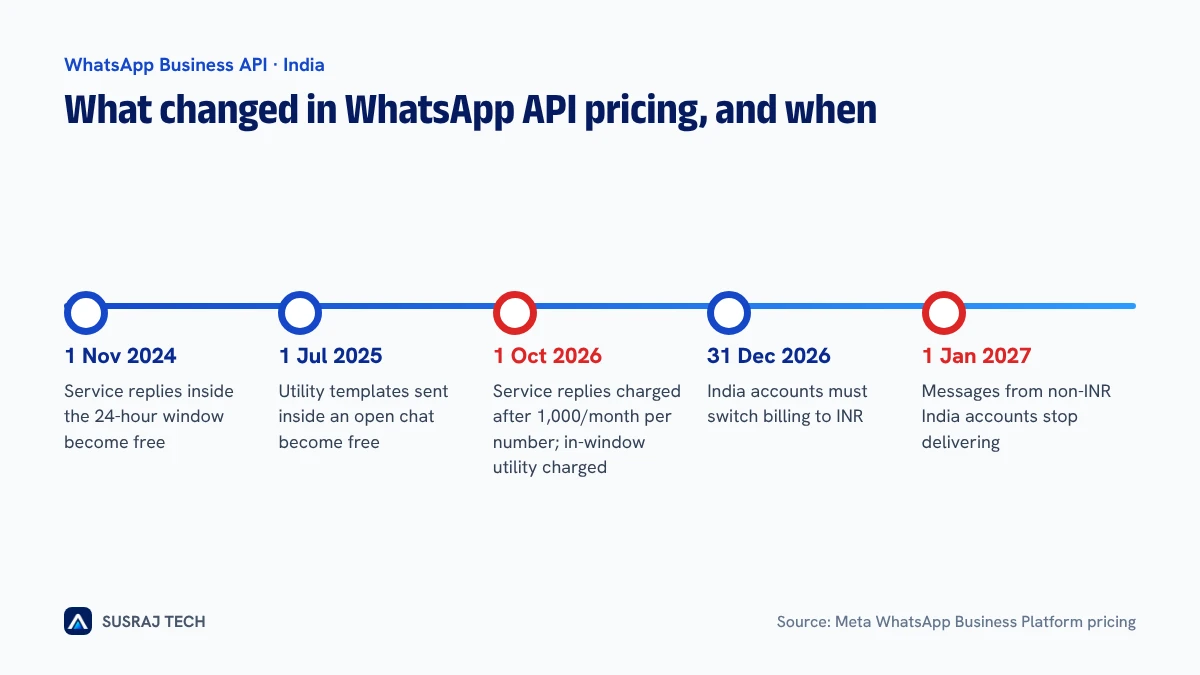 What changed, and when (source: Meta's WhatsApp Business Platform pricing page)
What changed on 1 October 2026
Meta updated its WhatsApp Business Platform pricing with three changes that matter to Indian businesses:
- Service replies are charged again. A service message is a free-form reply you send inside the 24-hour window after a customer messages you. These had been free since 1 November 2024. Now each business phone number gets 1,000 free service messages per month, and every one after that is charged at the utility rate. Unused free messages do not roll over.
- Utility templates inside an open chat are charged. Order updates, receipts and booking confirmations sent while the customer's chat window is open used to be free. They are now billed like any other utility message, with no free tier.
- India accounts must bill in rupees. Accounts billed in India must move to INR by 31 December 2026. Meta says it will stop delivering messages from non-INR accounts from 1 January 2027.
Messages a customer sends you are still free, and chats that start from a click-to-WhatsApp ad or a Facebook Page button open a free entry-point window.
New WhatsApp API rates in India (₹ per message)
| Message type | What it is for | Approx. rate in India |
|---|---|---|
| Service | Free-form replies inside the 24-hour window | ₹0.115 (first 1,000/month free) |
| Utility | Order, delivery, payment and booking updates | ₹0.115 |
| Authentication | One-time passwords (OTP) | ₹0.115 |
| Marketing | Offers, launches, reminders to buy | ₹0.863 |
Rates are before 18% GST and before any fee your WhatsApp provider (BSP) adds on top. Meta revises rate cards from time to time, so check the current card in your provider dashboard before you budget.
Important: the bill is per message, not per conversation. A chatbot that answers in three short bubbles costs three times as much as one that answers in a single message.
What it will cost a typical small business
Here is a simple estimate for three common kinds of business, using the rates above and ignoring GST and provider fees.
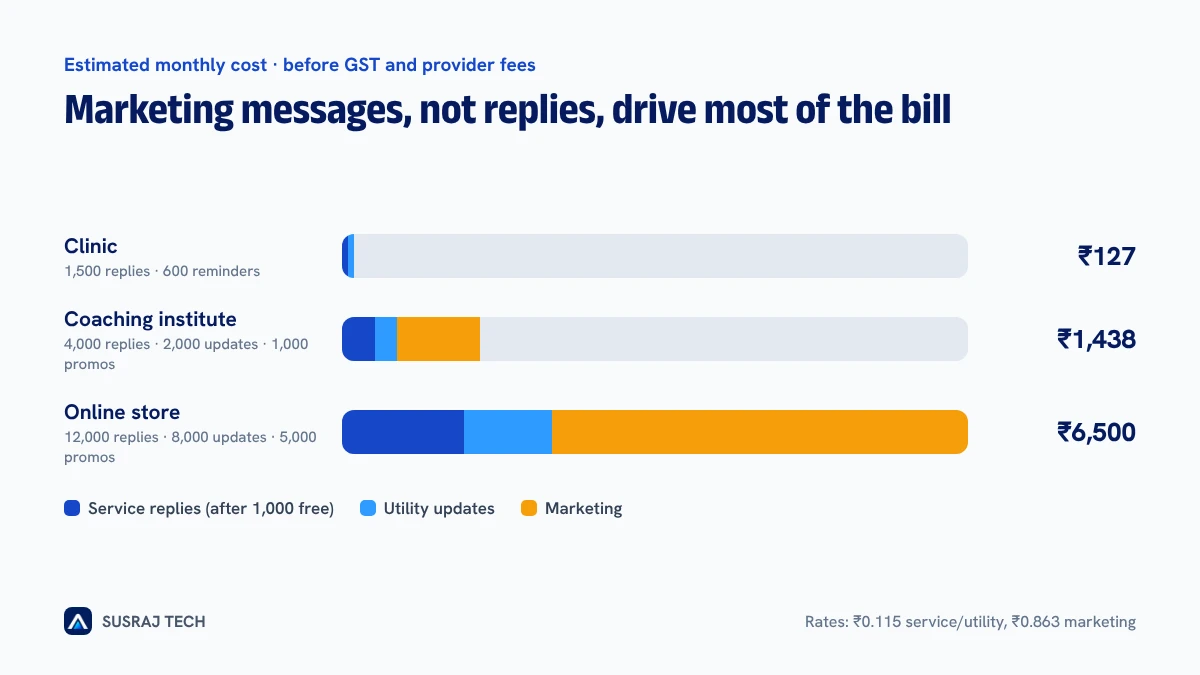 Estimated monthly WhatsApp API cost for three example businesses, before GST and provider fees
| Business | Monthly WhatsApp use | Estimated monthly cost |
|---|---|---|
| Clinic | 1,500 service replies, 600 appointment reminders, 0 marketing | (500 × ₹0.115) + (600 × ₹0.115) ≈ ₹127 |
| Coaching institute | 4,000 service replies, 2,000 fee and class updates, 1,000 promotional messages | (3,000 × ₹0.115) + (2,000 × ₹0.115) + (1,000 × ₹0.863) ≈ ₹1,438 |
| Online store | 12,000 service replies, 8,000 order updates, 5,000 promotional messages | (11,000 × ₹0.115) + (8,000 × ₹0.115) + (5,000 × ₹0.863) ≈ ₹6,500 |
Two things stand out:
- For most small businesses the new service charge is small. The clinic pays about ₹60 a month extra.
- Marketing messages are the real cost. In the online store example, promotions are two-thirds of the bill. That is where smart targeting saves the most money.
If you send far more than this, the bigger risk is not the rate but a chatbot that talks too much: long multi-bubble answers, menus that need many taps, and repeated "Did that help?" follow-ups all multiply your message count.
7 ways to keep your WhatsApp bill low
- Answer in one message. Combine text, a link and buttons into a single reply instead of three or four bubbles.
- Use interactive buttons and lists. One message with "Track order / Talk to us / Pricing" buttons replaces a long back-and-forth.
- Send customers to your website for long answers. A clear FAQ page or a website chatbot costs nothing per message.
- Run click-to-WhatsApp ads for lead generation. Chats that start from these ads open a free window, so your first replies to new leads are not billed.
- Segment your broadcasts. Send offers only to customers who bought or clicked recently. Halving a 5,000-message promotion saves about ₹2,150 a month.
- Add a payment method now if your provider bills you directly through Meta. Without one, your bot stops replying after the free 1,000 messages.
- Switch to INR billing before 31 December 2026 so your messages are not cut off in January.
Should you still use the WhatsApp API?
Yes, for most businesses. Even after this change, a WhatsApp reply costs about 11 paise, far cheaper than an SMS, a phone call or a missed lead. What has changed is that efficient design now matters: a well-built bot that resolves questions in fewer messages costs less and converts better.
A good setup usually looks like this:
- Website answers common questions and captures enquiries for free.
- WhatsApp bot handles order status, bookings and quick questions in as few messages as possible.
- CRM stores every lead so your team follows up once, not five times.
- AI drafts replies from your own content, with a human taking over for anything unusual. See our guide to AI chatbots for business and AI agents.
Checklist: what to do this week
- Open your provider dashboard and check last month's service message count per phone number.
- Confirm a payment method is on file.
- Check your billing currency and plan the switch to INR.
- Review your bot flows for multi-bubble replies and merge them.
- Move promotional broadcasts to segmented lists.
- Add a website FAQ or chatbot for the top 10 questions customers ask.
Need help cutting your WhatsApp costs?
Susraj Tech builds AI chatbots and WhatsApp automations for Indian businesses, connected to your website and CRM. We can review your current bot flows, show you where messages are being wasted and rebuild them to use fewer, clearer messages. Get a free review and we will send you a short report with estimated savings.