If you sell online in India, one line from a government FAQ now affects your margins: UPI payments to merchants above ₹2,000 attract a merchant discount rate, or MDR. This guide explains the rule in plain language, shows what it does to a few typical orders, and lists what an online store, app or subscription business should check.
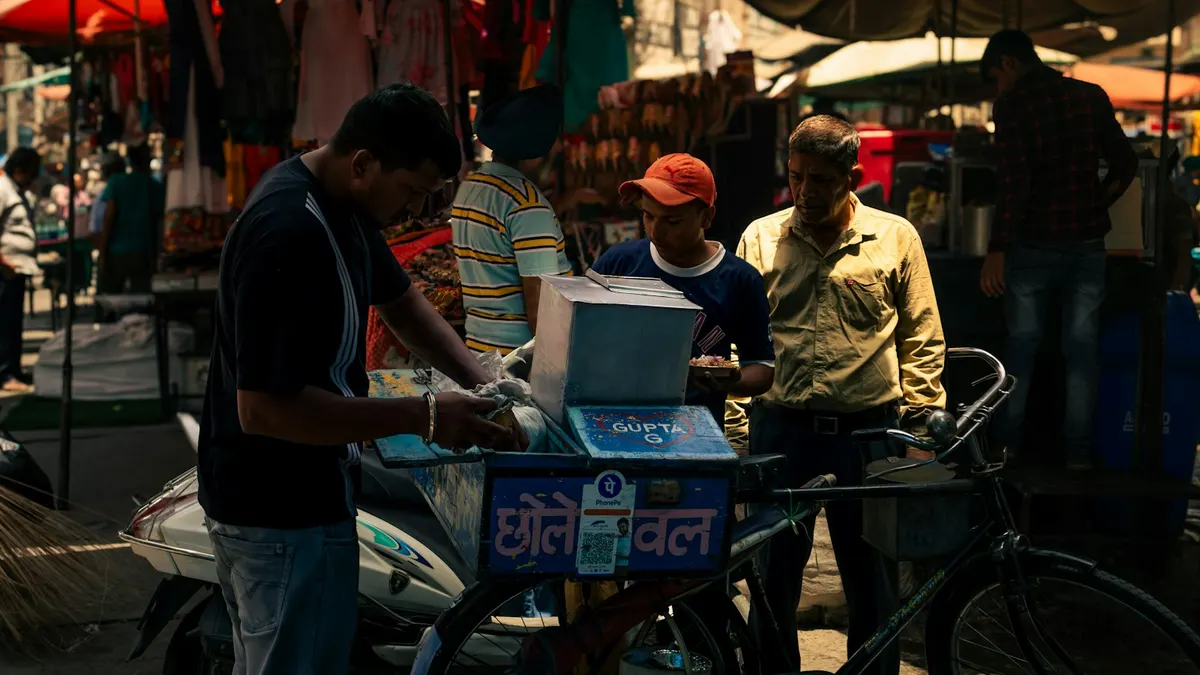 Small vendors who qualify as P2PM merchants stay at zero MDR. Photo: Anurag Jamwal on Unsplash
The short answer
On 15 September 2026 the Department of Financial Services published FAQs on MDR for select UPI person-to-merchant (P2M) transactions. According to that document, the framework takes effect from 15 October 2026:
- 0.4% MDR on P2M UPI transactions above ₹2,000.
- Capped at ₹300 per transaction for payments of ₹75,000 and above.
- Up to ₹2,000: no MDR.
- Flat ₹5 per transaction above ₹2,000 for certain categories such as railways, telecom, insurance and fuel.
- 0.02%, capped at ₹300, for capital-market payments such as mutual funds and brokers.
- Zero MDR for small P2PM merchants, UPI AutoPay and person-to-person transfers.
Customers are not charged, and merchants cannot pass the fee on. The cost sits between you and your acquiring bank or payment provider, so the practical work is checking how your provider applies it.
What the numbers look like on real orders
The FAQ gives its own examples, and the arithmetic is simple:
| Order value | MDR | What the merchant pays |
|---|---|---|
| ₹2,000 | none | ₹0 |
| ₹3,000 | 0.4% | ₹12 |
| ₹50,000 | 0.4% | ₹200 |
| ₹75,000 and above | capped | ₹300 |
The document also notes that a ₹1,00,000 payment would not pay ₹400, because the ₹300 cap applies.
Here is an illustration based on our own assumption, not a figure from any source. If an online store takes 1,000 UPI orders a month, each ₹3,000, and all of them are eligible P2M payments, the MDR would be about ₹12,000 a month. If the same store's average order is ₹1,500, none of those payments would attract MDR. That is why your order-value mix matters more than the headline rate.
Who is not affected
Reading the FAQ closely, these cases are outside the prescribed MDR:
- Small merchants in the P2PM category. These are small vendors receiving up to ₹1 lakh a month through UPI QR directly into their accounts. GST registration is not required to qualify. The document says banks watch inward credits, and a merchant above ₹1 lakh a month for three consecutive months moves to the P2M category.
- UPI AutoPay and mandates. Recurring payments for utility bills, OTT subscriptions and investments do not carry the prescribed MDR.
- Credit-linked UPI. The FAQ says UPI payments made with credit cards linked to UPI or pre-sanctioned credit lines follow credit product rules, and that this MDR applies to direct account-to-merchant-account UPI transactions.
- Peer-to-peer transfers, including self-transfers, which stay free.
- Customers. The FAQ says consumers pay no UPI charge and that UPI apps cannot levy a platform fee.
One thing the FAQ leaves for later: a dedicated fund to support small-merchant acceptance in smaller towns and under notified government schemes. The document says its detailed framework will be finalised with the RBI within three months of the announcement, so expect more detail rather than a final answer today.
Why this matters for websites and apps, not just shops
Most coverage talks about street vendors and retail counters. If you run an online store, a booking site, an education platform or a SaaS product that accepts UPI at checkout, three things deserve a look:
- Your payment provider's pricing and statements. The FAQ says acquiring banks, payment aggregators, fintech applications and accounting platforms were given lead time to update their systems. How a given provider presents or bills this is its own matter, so read your latest statement and any notices rather than assuming.
- Your price list. The FAQ is explicit that merchants cannot pass MDR to customers, so a "UPI surcharge" line on your checkout would go against it. If you want to protect margin, adjust prices openly or steer customers toward lower-cost options, but check the rules with your provider first.
- Your payment mix. Subscriptions on AutoPay carry no prescribed MDR, while one-time high-value UPI orders may. That can change how you design plans and invoicing.
For a build that touches payments, our e-commerce development service covers checkout design, and our posts on website development cost in India and Shopify vs custom e-commerce show where payment costs sit in the bigger picture.
What to ask your payment provider
A short, specific email gets a clearer answer than a general query. Ask which of your payment methods are treated as P2M UPI, from which date the MDR is applied to your account, and whether it appears as a separate line on settlement reports or is netted from payouts. Ask how refunds are handled for payments that attracted MDR, and whether your merchant category falls under a flat-rate or special tier. Keep the reply, because it is the document your finance team will reconcile against.
A short plan for this week
- Download your last month's payment provider statement and note how UPI payments above ₹2,000 are shown.
- List your order values and count how many UPI payments exceed ₹2,000.
- Ask your provider in writing how the 0.4% MDR, the ₹300 cap and any flat-rate categories apply to your account.
- Confirm whether you qualify for P2PM (up to ₹1 lakh a month into your own account) or are on a merchant account.
- Check that no customer-facing page adds a UPI fee or surcharge.
- Review whether subscription plans can move to UPI AutoPay mandates, which carry no prescribed MDR.
- Update your cost-per-order and margin sheet with the new numbers.
- Re-read official updates from the Ministry of Finance, RBI or NPCI before changing prices, because the details may be refined.
Common mistakes to avoid
Assuming every UPI payment is free or every one costs 0.4%. The threshold, merchant category and account type decide the answer.
Adding a surcharge. The government FAQ says merchants cannot pass MDR to customers.
Forgetting recurring billing. AutoPay is outside the prescribed MDR, which is relevant if you sell subscriptions.
Relying on social media summaries. The FAQ itself warns against forwarding unverified messages and points to PIB, RBI and NPCI as primary sources.
Changing prices before reading your provider's notice. The rules on paper and the way your provider bills them can differ in timing and presentation.
Key takeaways
- A 0.4% MDR applies to eligible P2M UPI payments above ₹2,000 from 15 October 2026, capped at ₹300 for ₹75,000 and above.
- Payments up to ₹2,000, P2P transfers, AutoPay and small P2PM merchants are outside it.
- Customers pay nothing extra, and merchants cannot pass the fee on.
- Your order-value mix decides how much it costs you.
- Check your provider's statements, then update your margin model.
- Follow official NPCI, RBI and Ministry of Finance updates for further detail.
Building or reworking a checkout, subscription flow or payment integration? Talk to Susraj Tech.
Sources
- Department of Financial Services: FAQs on Merchant Discount Rate (MDR) on Select UPI (P2M) Transactions, 15 September 2026
- HDFC Bank: New UPI Rules 2026, what the latest government announcement means
Last reviewed 29 October 2026. This article is general information, not financial or legal advice. Rules and provider practices can change, so check current notices from NPCI, the RBI and your payment provider.