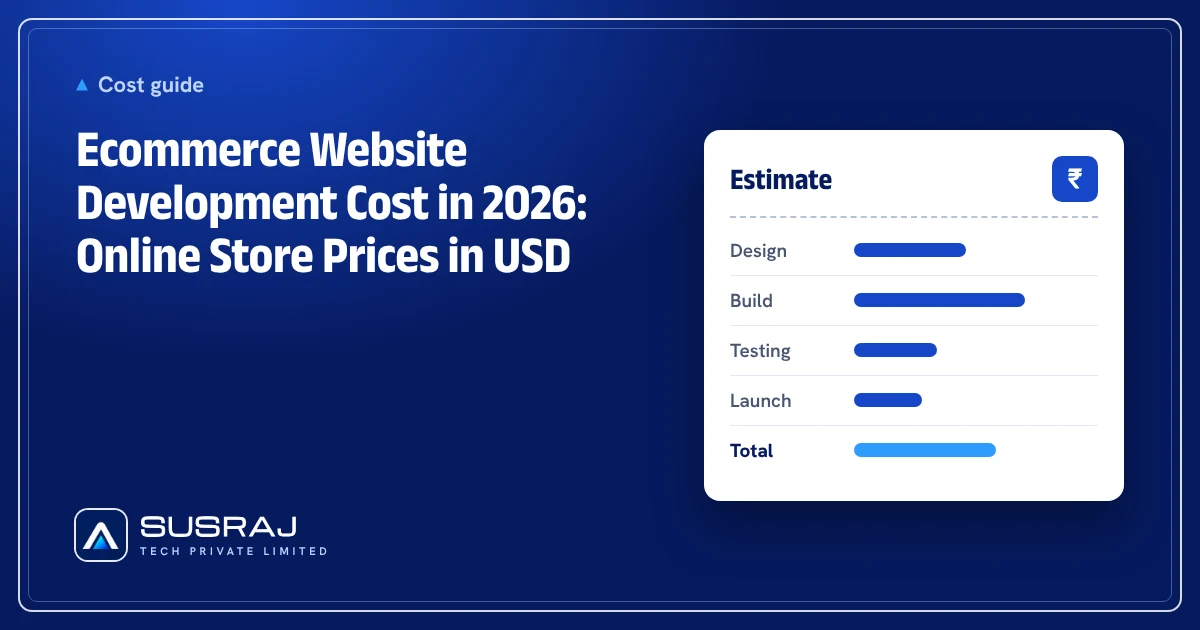
Before you launch an online store, you need two numbers: what the store costs to build, and what it costs to run each month. Here are realistic USD ranges for 2026, what moves the price and how to start lean.
Ecommerce website cost at a glance
These are indicative prices for a fixed-scope build, not a quote. They match the ranges our quick estimate on the home page shows US visitors.
| What you build | What it includes | Typical price (USD) | Typical timeline |
|---|---|---|---|
| Single-product landing page | One product or offer, design, build, buy button or order form | $250 – $500 | About 1 week |
| Catalog website | 5–10 pages showing products, with enquiry forms instead of online checkout | $500 – $1,200 | 1–2 weeks |
| Custom online store | Product catalog, cart, checkout, payments and order emails | $1,200 – $2,500 | 2–3 weeks |
| Store plus mobile app | The store above, plus an Android and iOS shopping app on the same backend | Add $2,500 – $6,000 | Planned with the app |
| Large catalog or marketplace | Hundreds of products, many vendors, complex shipping or ERP integration | Priced from a written feature list | Agreed in the scope |
Our website cost calculator lets you refine the estimate for your number of pages, products and features.
What changes the price
- Number of products. A few dozen products are quick to set up. Hundreds or thousands need import tools, filters and better search.
- Design. A customized template costs less than a fully custom design, and premium animation adds more.
- Payments. One payment provider is standard. Subscriptions, deposits, multiple currencies or buy-now-pay-later add work.
- Shipping and tax. Flat-rate shipping is simple. Live carrier rates, multiple warehouses and tax rules by state take longer.
- Integrations. Connecting inventory, accounting, a CRM or a marketplace channel adds build and testing. Read what API integration involves.
- Customer accounts. Logins, order history, wishlists and loyalty points add screens and logic.
Shopify or a custom store?
| Option | Upfront cost | Ongoing cost | Best for |
|---|---|---|---|
| Hosted platform such as Shopify | Low | Monthly plan, app subscriptions, transaction fees | Testing a product quickly with standard features |
| Custom online store | Higher | Hosting, payment-processor fees and maintenance | Your own design, custom features, no platform limits |
Our full comparison of Shopify vs custom ecommerce goes through features, fees and when to switch.
Running costs after launch
- Hosting and the domain, which grow with traffic and product images.
- Payment-processor fees on every order.
- Email, shipping and tax services, if you use them.
- Maintenance: security patches, updates, bug fixes and small changes. Budget for it every year instead of treating launch as the end.
How to keep the cost down
- Launch with your best-selling products first and add the rest once orders come in.
- Use one payment provider and flat-rate shipping for version one.
- Start with a customized template design if your brand is still evolving.
- Get found from day one: our ecommerce SEO guide covers product pages, categories and structured data.
- Agree a fixed price for a fixed scope. See fixed price vs time and materials.
Get a written quote
Susraj Tech builds online stores for businesses in the US, India and worldwide through our ecommerce development service. Tell us what you sell and we will send a free, written quote in USD with the scope, timeline and price.