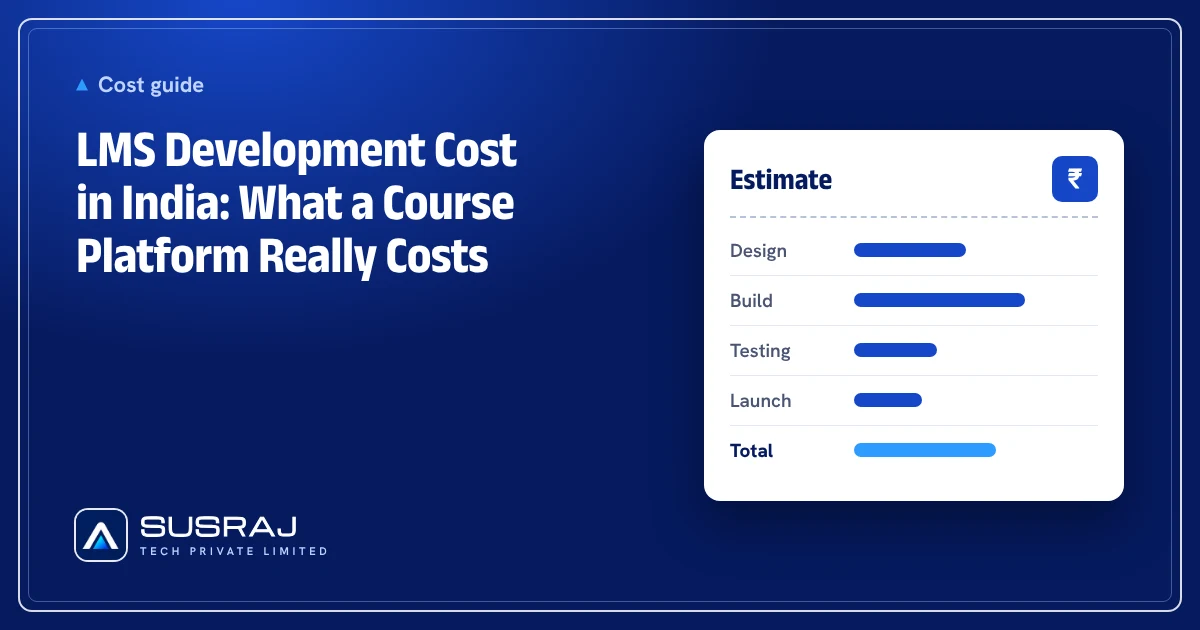
If you run a coaching centre, teach a skill online or train your own staff, the first question is usually the same: how much does an LMS cost to build? Here are realistic ranges for India, what moves the price, and what you keep paying after launch.
LMS development cost at a glance
All figures are indicative ranges, not a quote. They come from the same model as our website cost calculator and app cost calculator, so you can refine them for your own project.
| What you build | What it includes | Indicative cost | Typical timeline |
|---|---|---|---|
| LMS web portal | Student and admin logins, course pages, video lessons, quizzes, progress tracking | ₹50,000 – ₹1 lakh | 3–4 weeks |
| Portal with payments | Everything above, plus paid courses with UPI and card payments | ₹65,000 – ₹1.6 lakh | 3–4 weeks |
| Portal with integrations | Payments, plus CRM or email integrations and more than one language | ₹1 lakh – ₹3 lakh | 3–5 weeks |
| Learning app (Android + iOS) | Cross-platform app with lessons, quizzes and progress, plus its backend | ₹5 lakh – ₹12 lakh | 8–16 weeks |
Most coaching institutes and course creators start with a web portal. It works on every phone and laptop through the browser, costs a fraction of a native app, and can be turned into an app later once you know what students actually use.
What changes the price
- Number of user roles. Students and an admin is the simplest setup. Separate teacher, parent or corporate-manager dashboards add screens and permissions.
- Video. Uploading recorded lessons is straightforward. Live classes, DRM-protected video or download limits add work and running costs.
- Assessments. Simple multiple-choice quizzes are cheap. Timed tests, question banks, negative marking and rank lists take longer.
- Payments and access rules. One-time course fees are simple. Subscriptions, batches, coupons and instalments need more logic.
- Certificates and reports. Auto-generated certificates and progress reports for parents or managers are common add-ons.
- Languages. Hindi plus English, or more regional languages, adds translation and testing time.
- Integrations. Connecting to your CRM, WhatsApp, email tools or an existing student database is priced per integration.
If you are still deciding which features matter, read how to build an e-learning platform first; it walks through the features and monetisation models in detail.
Custom LMS vs Moodle vs a hosted course platform
| Option | Upfront cost | Ongoing cost | Best for |
|---|---|---|---|
| Hosted course platform | Low | Monthly subscription, sometimes a share of sales | Testing whether people will pay for your course |
| Moodle (open source) | Setup, theming and plugins | Hosting and maintenance | Schools that need a traditional LMS and have technical help |
| Custom LMS | Higher | Hosting and maintenance only | Your own brand, your own rules, no per-sale platform fee |
A hosted platform is the fastest way to validate a course idea. A custom LMS makes sense once you have students and want your own branding, your own pricing rules, or features the platform does not allow.
Running costs after launch
Plan for these from day one:
- Hosting for the website and database.
- Video storage and streaming. This grows with the number of students and hours watched, so it is often the largest running cost.
- Payment-gateway fees on each sale.
- Email, SMS or WhatsApp messages for logins, reminders and receipts.
- Maintenance. For an LMS web portal we estimate roughly ₹5,000 – ₹30,000 a year for updates, fixes and small changes, excluding hosting and video.
How to keep the cost down
- Launch with one course format (recorded or live) instead of both.
- Use a web portal first and add a mobile app only when students ask for it.
- Keep the first version to the features that sell the course: lessons, quizzes, payments and progress.
- Agree a fixed price for a fixed scope. Our guide to fixed price vs time and materials explains when each model fits.
Get a written quote
We build LMS portals and learning apps for schools and coaching institutes, trainers and startups. See our SaaS and web app development service, or tell us about your courses and we will send a free, written quote with the scope, timeline and price.
For mobile apps beyond learning, see our full breakdown of app development cost in India.