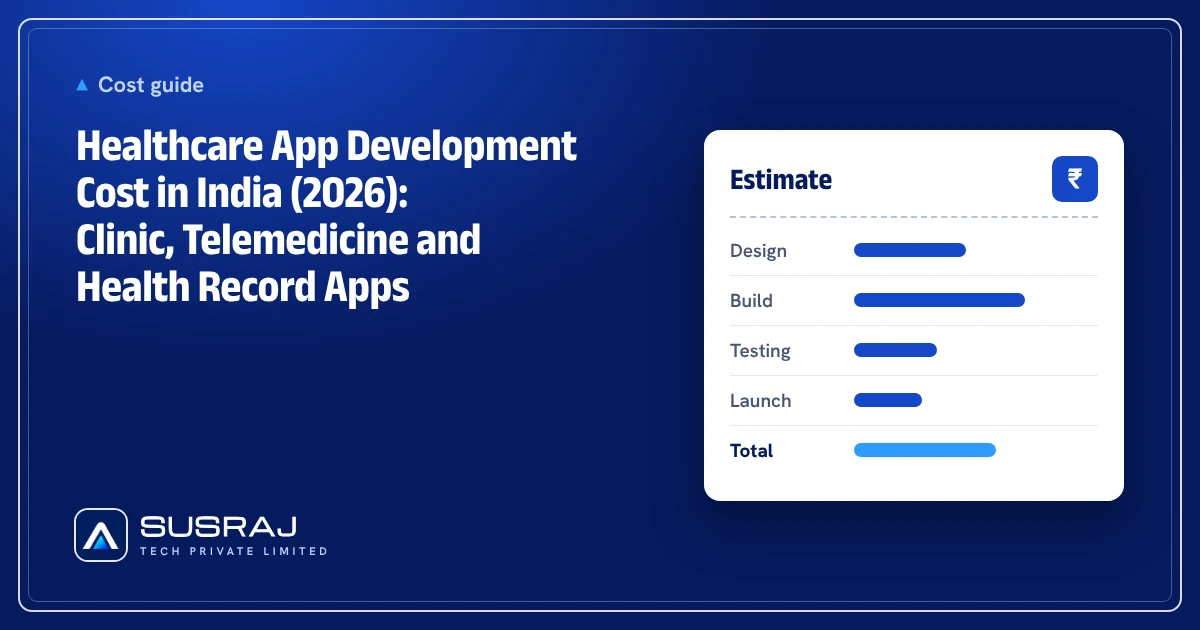
Clinics, diagnostic labs, pharmacies and health-tech founders all ask the same first question: how much will a healthcare app cost, and how much of it do we need in version one? The answer depends mostly on one thing: whether the app stores patients' health information. Here are realistic ranges for India in 2026, what moves the price and how to keep the first release focused.
 Once an app holds consultations, prescriptions or reports, it needs the security and consent work that makes healthcare builds cost more than a booking app. Photo: Bermix Studio on Unsplash
The short answer
- A healthcare app that handles patient data, built once for Android and iOS, typically costs ₹12 – ₹30 lakh and takes about 16–32 weeks, before add-ons.
- A telemedicine app with video calls, chat, payments, push notifications and an admin panel comes to about ₹17.3 – ₹43.1 lakh over 21–42 weeks.
- An Android-only first version costs about ₹8.4 – ₹21 lakh over 14–27 weeks, before add-ons.
- A clinic appointment app that only books slots, with no medical records, is priced as a booking app: about ₹50,000 – ₹1 lakh in 3–4 weeks.
- Maintenance is roughly 15–20% of the build cost a year.
All figures are indicative ranges, not a quote. They come from the same model as our app cost calculator, using its "fintech / health app" option for builds that handle health data and its "booking / service app" option for simple appointment apps.
Healthcare app cost at a glance
| What you build | What it includes | Indicative cost | Typical timeline |
|---|---|---|---|
| Clinic or lab booking app | Services, doctors, time slots, bookings and reminders, with no medical records | ₹50,000 – ₹1 lakh | 3–4 weeks |
| Health app, Android only | Patient accounts, secure login, records, consultations or tracking on Android | ₹8.4 lakh – ₹21 lakh | 14–27 weeks |
| Health app, Android + iOS | The same from one cross-platform codebase | ₹12 lakh – ₹30 lakh | 16–32 weeks |
| Telemedicine app, Android + iOS | The above plus video calls, chat, payments, push notifications and an admin panel | ₹17.3 lakh – ₹43.1 lakh | 21–42 weeks |
| Two fully native apps | Separate Android and iOS code, before add-ons | ₹20.4 lakh – ₹51 lakh | 22–45 weeks |
Common add-ons for a cross-platform health app, priced from the same model:
| Feature | Adds about |
|---|---|
| Video or audio consultations | ₹1.8 lakh – ₹4.5 lakh |
| In-app chat with doctors or staff | ₹1.2 lakh – ₹3 lakh |
| Online payments (UPI, cards, wallet) | ₹60,000 – ₹1.6 lakh |
| Push notifications for appointments and medicines | ₹20,000 – ₹50,000 |
| Admin panel for doctors, slots, patients and payments | ₹1.5 lakh – ₹3.5 lakh |
| Integrations (labs, pharmacies, hospital systems) | ₹80,000 – ₹2.5 lakh |
| Multiple languages | ₹50,000 – ₹1.5 lakh |
| Analytics and reports | ₹50,000 – ₹1.5 lakh |
| Offline mode for field staff | ₹60,000 – ₹1.8 lakh |
| AI features (symptom intake, summaries, chat support) | ₹2 lakh – ₹6 lakh |
In our model each add-on also adds about 6% to the timeline, which is why five add-ons move a 16–32 week build to about 21–42 weeks.
Which kind of healthcare app are you building?
"Healthcare app" covers very different products. The type decides both the price band and how much compliance work you need:
- Clinic, lab or salon-style booking apps. Patients pick a doctor or test and a time slot, and get reminders. If the app stores only names, phone numbers and appointment times, it is a booking app. Our booking app development cost guide covers this shape in detail.
- Telemedicine and doctor consultation apps. Video or chat consultations, prescriptions, payments and follow-ups. These handle health information and need the full health-app treatment. Our guide on how to build a telemedicine app walks through the features.
- Health record and patient portal apps. Reports, prescriptions, vaccination records and visit history in one place for patients and staff.
- Pharmacy and lab ordering apps. Prescription upload, orders, home sample collection and delivery, often closer to an on-demand or shopping app with health data on top.
- Fitness, wellness and remote monitoring apps. Habit tracking, readings from devices and alerts to care teams. Apps that only track steps or workouts sit nearer a normal app; apps that send readings to doctors are health builds.
What changes the price
Health data and security
Once an app stores consultations, prescriptions or reports, it needs secure login, role-based access for doctors, staff and patients, encryption, session limits and a record of who opened what and when. This work runs through every screen, which is why the base price for a health app is higher than for a booking or shopping app.
Consent and data protection
Health information is personal data, so the app must collect clear consent, let users see and correct their data, and protect it. India's Digital Personal Data Protection framework applies to most apps that collect personal data; our DPDP rules compliance checklist covers the basics. If you also serve US patients, our HIPAA checklist for custom healthcare software explains what changes.
Medical-practice rules
If doctors consult patients through the app, check India's Telemedicine Practice Guidelines (2020) with your medical and legal advisers before you design the consultation and prescription flow. If you plan to connect to the Ayushman Bharat Digital Mission (ABDM) for health records, plan that integration and its approvals into the scope from the start.
Video, chat and integrations
Video consultations and chat are among the larger add-ons in our model, and they bring running costs for call minutes and messages. Connecting to lab systems, pharmacies, hospital software or device APIs adds build and testing time for each connection. Read what API integration involves.
Platforms
In our model one platform costs about 30% less than one cross-platform app and is about 15% faster, while two fully native apps cost about 70% more and take about 40% longer. Many clinics start with one platform and add the other later. Our guide to Android app development cost in India compares the options.
Admin and doctor tools
Doctors and front-desk staff need to manage slots, see the day's patients, write notes and handle refunds. If the doctor or admin side is slow to use, staff will avoid it, so plan it as carefully as the patient app.
Running costs after launch
- Servers and the database, with backups and monitoring.
- Video-call and messaging services, usually billed by minutes or messages used.
- SMS, email and push notifications for OTPs, appointment reminders and medicine alerts.
- Payment-gateway fees on each consultation or order.
- Security reviews as the number of patients grows.
- Maintenance: security updates, Android and iOS changes, bug fixes and small improvements. We estimate roughly 15–20% of the build cost a year.
- App stores: Google Play charges a one-time 25 US dollar registration fee and Apple 99 US dollars a year, if you launch on iOS.
How to get a quote you can compare
- Write down exactly what health data the app collects, stores and shows, and who can see it.
- List the user types: patients, doctors, front-desk staff, lab or pharmacy partners and admins.
- Pick the 5–10 things each user must be able to do in version one.
- Decide whether consultations are by video, chat or both, or not in version one.
- List the systems it must connect to, such as lab software, a pharmacy partner or ABDM.
- Decide whether you need iOS now or can launch on Android first.
- Ask for a fixed price for a fixed scope for each phase. Read fixed price vs time and materials.
- Confirm in writing that you own the code, the backend, the data and the app-store accounts.
Common mistakes to avoid
- Building a health app when a booking app would do. If you only need appointments and reminders, keep medical records out of version one and save most of the budget.
- Leaving security and consent for the end. Adding access controls and audit trails later means reworking screens.
- Designing consultations without medical advice. Check the practice rules for teleconsultation and prescriptions before the flow is built.
- Forgetting the doctor side. If doctors cannot manage slots and notes quickly, they will go back to phone calls.
- Underestimating running costs. Video minutes, SMS reminders and security reviews continue every month.
For other app types, see our breakdown of app development cost in India and the related fintech app development cost guide, which uses the same higher-compliance price band.
Key takeaways
- A healthcare app that handles patient data typically costs ₹12 – ₹30 lakh for Android and iOS before add-ons.
- A telemedicine app with video, chat, payments, push and an admin panel is about ₹17.3 – ₹43.1 lakh over 21–42 weeks.
- A clinic booking app without medical records is priced as a booking app, about ₹50,000 – ₹1 lakh.
- Security, consent, consultation features and integrations drive the price.
- Check data-protection and medical-practice rules early, and budget 15–20% of the build cost a year for maintenance.
Get a written quote
We build healthcare, telemedicine and clinic booking apps through our mobile app development service. Tell us about your healthcare app and we will send a free, written quote with the scope, timeline and price.
Sources
- Ministry of Electronics and IT: Data Protection Framework
- Google Play Console Help: Create and set up your developer account
- Apple: Apple Developer Program
- Susraj Tech pricing model in our app cost calculator (fintech / health and booking app types, platform options and feature add-ons).
Last reviewed 8 November 2026. Prices are indicative ranges, not a quote. This article is general information, not legal, medical or regulatory advice; confirm the rules that apply to your product with qualified advisers.